
OCD Therapy for Trauma Survivors
in Lynchburg, VA
Online in VA, FL, SC, & VT
Support for complex trauma survivors
with harm, moral scrupulosity, contamination, & checking OCD
When OCD Turns Safety Into Unending Threat
You might feel trapped in your own mind, endlessly questioning your actions, your intentions, or whether you’re keeping yourself and others safe. Mental checking, rumination, and spiraling doubts can take over your day, making even simple decisions feel impossible.
It’s exhausting, like your brain is running a marathon it didn’t sign up for. For many trauma survivors, OCD can make you distrust your own mind, second-guess your instincts, or avoid situations where your thoughts might be “tested.” Even ordinary moments— deciding how to respond to triggers or triggering past experiences— can feel mentally draining, leaving you frustrated, anxious, and longing for clarity and relief.
You might even worry that your intrusive thoughts reveal something about you— but the truth is, these patterns are driven by OCD, not by who you truly are.

How OCD Can Show Up in Trauma Survivors in Lynchburg, VA

OCD often latches onto things that feel morally urgent, dangerous, or unresolved for trauma survivor minds: past events, responsibilities, and perceived threats. For trauma survivors, this may look like:
Harm OCD: Fears of accidentally hurting others, despite no intent.
Moral Scrupulosity OCD: Obsessive fear of being “bad” or unethical, especially in relation to past trauma or your values.
Contamination OCD: Fears of illness, germs, or hazards, sometimes linked to trauma-related hypervigilance.
Checking OCD: Repeated checking to feel certain or prevent mistakes.
These patterns can be overwhelming and isolating, but they’re driven by OCD— they don’t define you. With specialized OCD therapy, you can learn to recognize your own OCD and start reclaiming clarity and confidence.
Reclaim Clarity, Confidence, and Peace of Mind
You don’t have to stay trapped in doubt loops or compulsive checking. With Inference-Based CBT (I-CBT) and trauma-informed support, you can start to:
Notice the mental leaps fueling your doubt loops
Trust your instincts and decisions
Break free from mental exhaustion and hypervigilance
Feel more grounded and in control of your choices
I-CBT is a structured, evidence-based approach to help trauma survivors move from confusion to clarity. This approach works with your experiences of trauma— not against it— so you can trust your mind more and fear it less.

Affirming, Trauma-Informed OCD Therapy: Who It’s For

For trauma survivors (adults and teens 16+) who want OCD therapy that understands your trauma— where you can:
Skip the “Am I safe? Will I be understood?” scan
Bring intrusive/taboo thoughts openly, without judgment
Spend session time on OCD, not trauma education
Access discreet, private-pay telehealth
You don’t have to navigate this alone. With specialized, inclusive support, you can do deeper work on your OCD and feel more free in your life.
Why I Might Be a Good Fit for Your OCD Therapy in Lynchburg, VA
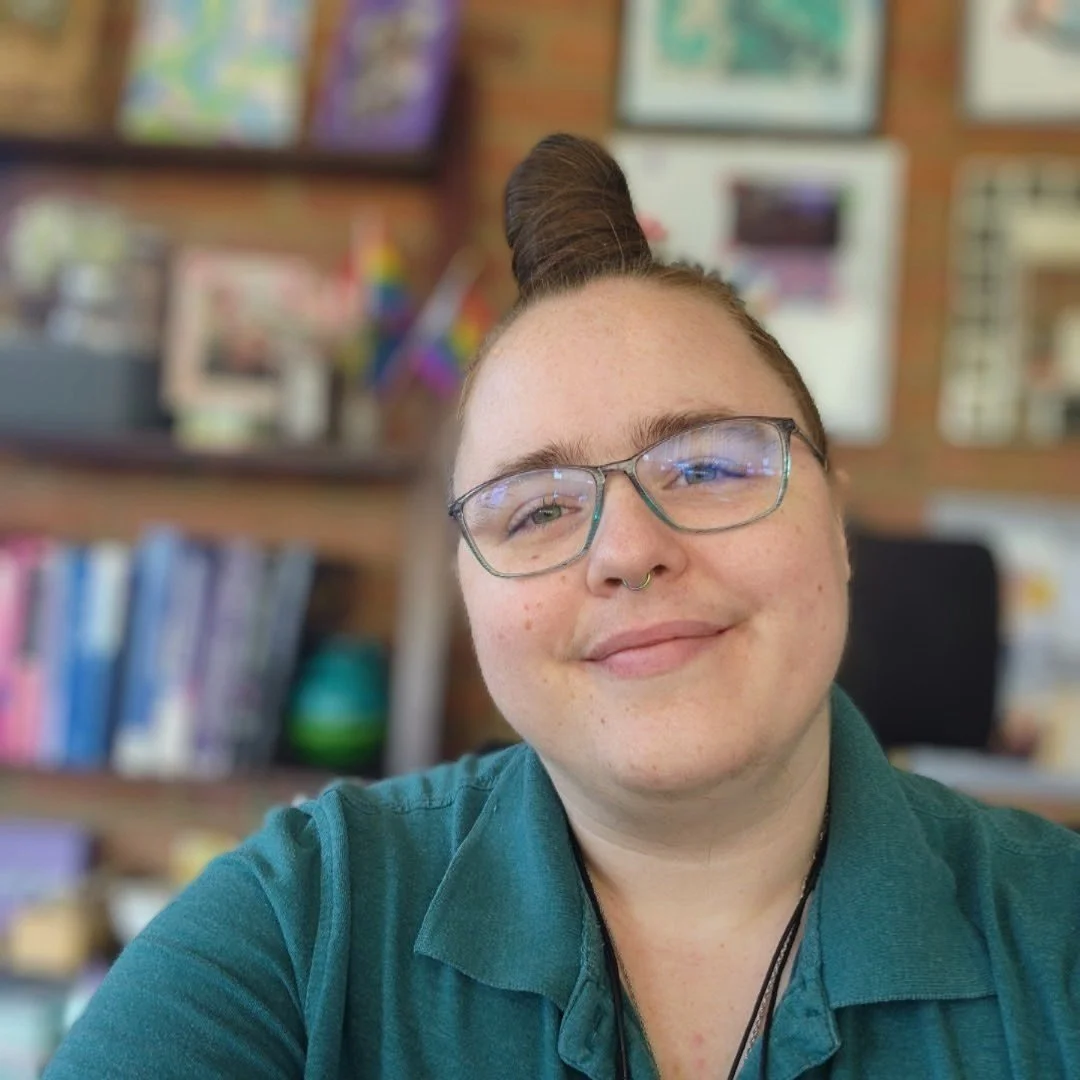
Struggling to find a therapist who’s the right fit? I’m a queer, trans, non-binary, AuDHD, non-monogamous therapist with lived experience of OCD, and I specialize in helping trauma survivors navigate OCD that targets your ethics, values, and sense of self.
I understand firsthand how intrusive thoughts and doubt loops can take over your day— and I provide private-pay, discreet telehealth so you can get support safely and conveniently.
In our work together, I combine lived experience with evidence-based I-CBT strategies so you can rebuild trust in yourself and restore clarity and focus. I meet you where you are, honoring your traumatic experiences, strengths, and challenges.
Ready to Break Free from the “What Ifs”?

You don’t have to untangle your OCD doubts alone.
Start recognizing the mental leaps your brain makes, and take the first step toward reclaiming clarity.
Schedule your free 15-minute consultation— camera optional.
FAQ
-
Does it ever feel like your own mind won’t give you a moment’s peace? Living with OCD can feel like your thoughts are running the show, pulling you into loops of distressing ideas and exhausting compulsions. You might find yourself wondering why you can’t just “let it go.” If this sounds familiar, you’re not alone— OCD is a common mental health condition, and help is possible.
OCD (Obsessive-Compulsive Disorder) involves two main parts: obsessions and compulsions.
Obsessions are unwanted, intrusive thoughts, images, urges, or sensations that keep popping into your mind, no matter how much you try to push them away. They often go against your values and what matters most to you— leaving you with anxiety, shame, or even disgust. OCD has a way of attacking the very things you care about most.
Compulsions are the mental or physical actions you feel driven to do in an attempt to ease the distress caused by your obsessions. Sometimes these are visible behaviors, like checking or washing. Other times, they’re invisible mental actions, like reviewing, ruminating, or trying to get 100% certainty before you can move on. Even when you know your compulsions are excessive, the urge to complete them can feel overwhelming.
If you’re feeling stuck, it’s not because you’re “broken” or “weak”— it’s because OCD creates a powerful cycle of fear and temporary relief that’s hard to break on your own.
There’s a way forward— toward trust, clarity, and the freedom to live as your true self.
-
What if the urgent problems OCD warns you about were never real in the first place?
Inference-Based Cognitive Behavioral Therapy (I-CBT) is an evidence-based approach created specifically for OCD. Unlike therapies that focus on your compulsions, I-CBT goes straight to the source— your obsessions, the intrusive doubts that start the cycle.
The goal of I-CBT is to help you reconnect with your senses, your common sense, and your real self— so you can see obsessional doubts for what they are: imaginary problems, irrelevant possibilities, not grounded in reality. When you realize the doubt itself doesn’t matter, the pull of compulsions naturally fades. There’s no battle, no endless resistance— just the clarity of knowing what’s real and what’s not.
I-CBT understands OCD as the result of “inferential confusion”— a type of faulty reasoning where you mistake an imagined possibility for a genuine threat, even when your direct experience tells you otherwise. OCD acts like a trickster, convincing you there’s an urgent danger that only compulsions can fix. I-CBT teaches you how to see through OCD’s lies, untangle the reasoning errors, and return to the present moment— where no real problem actually exists.
With the right support, you can reclaim your trust in yourself and live with more freedom, peace, and confidence.
-
What if you could finally trust yourself again— your senses, your memory, your real self?
Instead of getting pulled into OCD’s “what ifs” and endless compulsions, I-CBT helps you ground yourself in your own perception, common sense, and authentic self— the you that’s here in the present moment. OCD often convinces you that unless you perform your compulsions, you’ll become what I-CBT calls your “feared possible self,” a version of you that only exists in OCD’s stories.
Unlike other approaches that ask you to sit with uncertainty about who you are, I-CBT helps you to build on the functional certainty you already have— trusting what your senses and lived experience are telling you right now.
As Carl Robbins, LCPC, puts it:
“I-CBT holds out the possibility of restoring trust in one’s perception, one’s memory, & even one’s self. Discovering or rediscovering trust in oneself offers a much higher goal for recovery than learning to tolerate being uncertain about who we are.”Step by step, it’s possible to loosen OCD’s grip and rediscover the steady trust that was always yours.
-
Do your doubts seem to shape-shift— always finding new ways to keep you stuck? OCD can latch onto almost anything that matters to you, leaving you second-guessing your thoughts, actions, or even who you are.
I-CBT is effective for all sub-types of OCD.
Below are some of the sub-types I have clinical and/or lived experience with:
Checking OCD
Ethics & Morality OCD
Gender Identity OCD
Harm & Aggression OCD
Health OCD
Negligence & Mistakes OCD
OCD About OCD (Meta-OCD)
Relationship OCD
Religious OCD
Sensorimotor OCD
No matter how your OCD shows up, it’s possible to quiet the doubt, trust yourself again, and move toward a life guided by clarity and peace.
-
Yes! To book your complimentary initial 15-minute video consultation, simply click the below button.